
To Change Your Performance, Change Your Perspective

crosswalk

Running is one of my interests and favorite forms of exercise.  It also enables me to pursue one of my other interests: Eating. I am a small-time runner, averaging 10-12 miles per week. I find running to be an opportunity to learn and think as I have a collection of podcasts loaded on my iPod that accompany me on morning runs. My run last Saturday morning was a learning moment in another way. The 3.5 mile route I planned to take in my neighborhood was one that I had run more than 100 times in the past five years. Perhaps the frequency of running this particular route was one reason I was not all that excited about running it that morning.

A Change of Perspective

Then, the idea hit me to run the route in reverse (not running backwards but running the route backwards). The routine of the run called for going a prescribed route, but on this morning rather than turning right off my street, I turned left and had a new experience on an old route. I caught myself more than once during the run with a smile on my face, marveling at the different view I was enjoying merely by running in a different direction on the same roads that I always run. It reminded me of a suggestion made by an executive at Tom’s Foods during my time in the direct sales delivery business. He said that during his days driving a route truck he would occasionally run his daily route in reverse order. Doing so would be a way of dealing with monotony and gave him a different perspective on his route and customer accounts.

How You Can Change Direction

What can I share with you about my decision to turn left instead of right and change my running route? It gave me a new perspective on my surroundings even though I felt like I knew them already. As marketers, we can take a similar approach and “cross the street” to take a look at our business from the other side. Here are two ways to change your perspective:

  1. Act like a customer– When is the last time you stood in your customers’ shoes and looked at what it is like to do business with your company from their standpoint? If your organization is large enough, perhaps you can actually be a “mystery shopper” and put yourself in buying situations. Similarly, take on the perspective of a customer and attempt to shop your website. What is the experience like? I did this recently, taking on the perspective of a graduate student evaluating MBA programs. In addition to looking at websites of other universities, I went to the website at my university that houses information on the MBA program. I was dismayed by the poor organization of information and overall lousy user experience. Although design of the website is beyond my authority, I had a conversation with the administrator who is responsible for it. He agreed that it made for a bad user experience, and being new to the position he was making it a priority to make navigation of the site more user-friendly.
  2. Act like an employee– I enjoy watching the TV show “Undercover Boss.” In each episode, the company executive that goes undercover as a front-line employee is amazed and often dismayed by observations made about company culture, policies, and procedures.  The revelations come about not because of what the boss sees is new; they come about because their perspective changed. In addition to spending time gaining perspective from the trenches, consider how prospective employees perceive your company. Is it an open, inviting environment? Or, would a candidate get a vibe your company is more like a club or clique into which one is granted admission by other employees?

Embrace the View from the Other Side

Crossing the street and looking at your business from a different perspective entails some risk- you may not like what you see once you get there. But, if you aspire for improvement and growth (and I don’t know of any business that has the mindset “we are fine just as we are”), one way to make it happen is to change your perspective occasionally. Zig Ziglar said “If you keep doing what you’ve been doing, you will keep getting what you’ve been getting.” If you are a leader, commit to changing your perspective by looking at your organization from the perspective of others. As for my running routes, I plan to practice what I am preaching here and change my perspective more frequently from now on.

Photo credit: rgbstock.com

“Cs Get Degrees”… Now What?

Cs

College graduation season is upon us. This annual rite of passage is being experienced by graduates and their loved ones across the country. Members of the Class of 2014 have plenty of company; the National Center for Education Statistics estimates that 1.6 million Bachelor degrees will be conferred this year. Competition is intense for newly minted grads entering the workforce, both among themselves and against entrenched professionals looking to either move up in their careers or move on to new opportunities. Given this environment, today’s college graduates are challenged with differentiating themselves to gain an upper hand and launch their careers.

Spring Commencement was held at my university, Middle Tennessee State University, on Saturday. Although the ceremony was long (more than three hours), the energy and excitement in the arena coming from grads and their families makes the time pass rather quickly. At the same time, I like following related hashtags on Twitter to find out what grads and others in attendance are thinking and feeling. One tweet stood out on Saturday- It was from a grad who observed during the ceremony that “Cs get degrees.” Her self-congratulatory comment was cute, but at the same time I saw this person as someone who may not be prepared for the road ahead. Yes, she has degree in-hand, but what is that worth? It will not parlay directly into a job, nor will her degree assure a paycheck… or anything else, for that matter.

So what does a college degree give you in 2014? Here are three observations:

Your Degree = You’re Trainable

I once had a boss tell me during the interview process “your degree does not mean much to me. It tells me you’re trainable.” At the time, I was a bit offended and hurt by that remark. After all, I worked hard to join my brother as first-generation college graduates in our family. Now, someone who I hoped would hire me says my degree does not mean anything? In hindsight, I understand and appreciate what my boss was telling me. The classes I had taken to earn a degree in Marketing did not directly prepare me to perform the tasks as a sales representative. But, I was able to learn and adapt to the company’s systems and procedures in order to succeed in that position.

Your Degree = You’ve Been Exposed

Another indicator provided by a college degree is that you have been exposed to certain concepts, theories, and ideas that are relevant to a particular field or discipline. Traditionally, the value of a college degree via exposure came from the class lecture as professors sought to fill up students’ minds with facts. This system resembles going to a gas station, putting the pump in your car, and filling up. When students’ brains are “topped off,” it is time to graduate. The gas station model of higher education is being challenged as demand for new, specialized skills is creating a need for more hands-on learning to complement, if not overtake the lecture as dominant learning model. Thus, the value of exposure to knowledge is losing its edge as demand increases for more skilled graduates.

Your Degree = Your License to Compete

So if your college degree’s impact is limited to being an indicator of being trainable and exposure to subject matter, why should people bother investing time and money to pursue a degree? The answer is simple- Your degree is a license to compete in the marketplace. Employers are looking for evidence of being trainable and a knowledge base. Earning a college degree is a form of table stakes, allowing you “play” against others wanting the same thing as you. A degree is not a ticket to success; it is admission to the next round of competition in which you must differentiate your personal brand.

A New Beginning

To the student who boasted “Cs get degrees” and others in that category, unremarkable academic performance might put them at a competitive disadvantage for being considered for some jobs but is not a permanent disability. Given that a degree shows you are trainable, have been exposed to certain knowledge, and are eligible to compete in the job market, you are in the game. The question now becomes what does one do to build a distinctive brand.

Of course, there is precedent to the idea that C students can not only compete but thrive. Fred Smith, founder of FedEx, first developed ideas for his package delivery air service while a student at Yale University, Legend has it that he earned a C on the term paper about his idea. Smith says he cannot remember the grade, but the point is that he did not accept how others (namely his professor) constrained him. Your grades ultimately will not determine your success, but it is up to you to not accept mediocrity when it comes to your personal brand.

Building the Imperfect Personal Brand

Mistakes

Note: This is the third part of a three-part series on keys to building a personal brand, inspired by a blog post from Adii Pienaar titled “How to Build Your Personal Brand: The Next Step to Anything,” published August 18, 2013.

Of all the highly useful takeaways offered by Adii Pienaar in his article on building your personal brand, the suggestion with which I struggle most is accepting that my brand is a work-in-progress and as such it has imperfections and flaws that are exposed. To this end, Pienaar states:

You’re not perfect today and as such your personal brand has imperfections. To be successful in personal branding though, you don’t sweep those imperfections underneath a rug. Instead you embrace them, work at them and use them to help shape the truest representation of who you are.” 

In a world in which product brands obsess over every word in a press release or ad to make sure no embarrassment or negative feedback is experienced, we are being told by Pienaar to not worry about it.

Seek Forgiveness, not Perfection

The advice to embrace our imperfections or mistakes should make us feel liberated, freeing us from being paralyzed by the need that our brand always be perfect- on message, looking good, and building an ideal image. We can adapt the saying “Sometimes it is better to ask for forgiveness than permission” to our quest to build a personal brand by saying “Sometimes it is better to seek forgiveness than perfection.” Brands are on 24/7- they do not close or take time off like employees. Thus, it is inevitable that you will make mistakes or otherwise portray your brand in a way that falls short of the brand you wish to project to the world. You and I have to get over it- even the strongest brands will fail to live up to their brand ideal occasionally. But, we cannot let that likelihood stop us from doing the work we love and working to evolve our personal brand.

“Real (Brand) Artists Ship”

If you need another sign that it is OK to run the risk of showing weaknesses in your personal brand, reflect on the statement by Adii Pienaar that “real (brand) artists ship.” Is each book published by an author her new “best work ever?” Is each successive CD release by a band their new greatest release? Of course not. Although we would like to think the output of creative endeavors would represent a linear progression of better products and ideas, the reality is some works are not an improvement or are flawed in some way. The sooner we accept this characteristic about ourselves and our work, the sooner we can get out of our own way and strengthen our personal brand rather than obsessing over masking its imperfections.

It has been insightful for me to reflect on this article in my last three blog posts. If you have read one, two, or all three pieces I hope they have been of value as you manage your personal brand.

Writing Your Way to a Stronger Personal Brand

write2

Photo Credit: “Write“- Flickr/Sarah ReidCC BY 2.0

Note: This is the second of a three-part series on keys to building a personal brand, inspired by a blog post from Adii Pienaar titled “How to Build Your Personal Brand: The Next Step to Anything,” published August 18, 2013.

Among his five stepping stones for building a personal brand, Adii Pienaar advocates “email-first branding.” I was stopped in my tracks as I read this advice for I had never heard anything quite like this statement. First, I interpreted his suggestion literally and wondered how thinking email-first could possibly make a personal brand stronger. But, as I read on, Pienaar’s advice became clearer.  He points out that today’s professional communication is email-centric. Whether you are fond of email as a communication channel or not, the reality is we read and write extensively with peers, bosses, customers, and others. Simply put, becoming a more effective writer can make you a more effective professional.

Developing writing skill is like becoming more physically fit- when you work at it consciously and consistently you will get stronger. If you do it occasionally and without following proper technique, it will hurt! Here are three tips for making the desire to be a better writer a reality:

1. Look Out

Just as becoming a better oral communicator begins with sharpening listening skills, improving writing skills by first resolving to look out for writing that you find easy to read, enjoyable, and valuable. What is about the writer’s style that is appealing that you could comfortably incorporate into your own writing- Use of humor? Ability to tell captivating stories? Giving helpful advice? Showing empathy for others? Build a collection of RSS feeds that gathers works from magazine writers, newspaper columnists, bloggers, or others that write regularly and from whom you can find inspiration and ideas.

2. Work Out

Being a consistent consumer of writing is a start to becoming a better writer, but at some point you have to apply what has been learned. If you are not blogging already, I highly recommend getting into the game. I have been blogging since 2007, and it has been one of the best professional decisions I have ever made. For the first two or three years, I paid virtually no attention to audience reach, page views, etc.- I just wrote. For the first six years that I blogged I used a free service (Blogger) and found it be a good fit with my needs. My writing has focused on professional interests related to marketing, but I would have gotten just as much benefit and enjoyment had I blogged about fantasy baseball or being a father to three boys. Write about a subject that energizes you and work out regularly to build your writing “muscles.”

3. Seek Out

As you strengthen your writing skills, seek out opportunities to get even stronger by applying in situations in which writing is valued. An obvious starting point is to embrace the email-first branding advice of Adii Pienaar. Keep in mind that many outlets are virtually starved for quality content, meaning you could reach out to pitch ideas for contributing through your writing. For example, many company and organization newsletters are looking for articles to build out their weekly or monthly issues that reach employees and other stakeholders. Another tactic that is easy to implement is leaving replies to blogs or articles that you are reading. Give the writer and audience feedback while working on your own writing style.

One Word at a Time

One of my favorite quotes is “the best way to eat an elephant is one bite at a time.” Too often, we are overwhelmed by a task (eating the elephant) that we miss out on putting processes in place that break down the task into actionable steps (eating the elephant one bite at a time). The urging to become a better writer, while desirable, can be overwhelming when we think about how to achieve the outcome. How can I go from my current abilities to a far loftier place? Commit to weekly or even daily writing goals- posting to your blog three times a week, writing 500 words a day, writing a journal entry daily- to take the bites necessary to become a stronger writer.

What You Do Speaks Volumes about Your Personal Brand

trashonground

Note: This is the first of a three-part series on keys to building a personal brand, inspired by a blog post from Adii Pienaar titled “How to Build Your Personal Brand: The Next Step to Anything,” published August 18, 2013.

One of the challenges faced when developing your personal brand is determining strategies for the Message dimension of your brand. What communication channels should I use? What do I say? How often should I be communicating? These questions are valid and must be answered, but they also miss the mark. Questions pertaining to message channel, content, and frequency treat communication as a stand alone endeavor in branding. Such an approach is flawed because communication not based on your Meaning (values and purpose) and Makeup (mindset, skills, and competencies) is reduced to little more than words and noise.

Anything You Do is Everything You Do

The inspiration for this post and three-part series on building a personal brand comes from a story Adii Pienaar shares about a hiring manager who has an interesting way of evaluating job candidates. The hiring manager will place a piece of trash (e.g., a candy wrapper) on the floor and observe a candidate’s response (or lack of response) to the presence of the trash. Is it picked up, or does the person ignore it? The actions of the job candidate are observed and inferences made about such attributes as sensitivity to their surroundings and attention to detail.

The point made by the hiring manager is that “anything you do is everything you do.” Our actions are guided by values and beliefs. In general, we do not behave in a manner that is inconsistent with who we are. Of course, you may be able to “fake” who you really are when answering questions in a job interview. But, glimpses into your true character may be revealed by the simplest of actions such as picking up a candy wrapper off the floor.

Sending Signals

Like product brands, perceptions of personal brands are influenced by signals that the brand (you) sends. If you are skeptical, think about how these behaviors can influence your perceptions of other people:

  • Being chronically late to meetings and appointments(or being consistently early)
  • Volunteering to go beyond expected tasks or duties to help out others or the organization
  • Using inappropriate language or humor when interacting with co-workers or classmates
  • Being supportive of the pursuits and accomplishments of others.

A lengthy list could be presented, but you get the picture. The above behaviors may not be conscious efforts to communicate personal brand messages, but they can have the same impact as structured communications, if not greater. We send signals to the world around us, positive and negative, through our actions and interactions. Like a product brand, your personal brand is always “on.” People coming in contact with your brand will form perceptions about you- at work, church, school, restaurants- wherever you might be and whenever you are there.

I like the statement “anything you do is everything you do,” and I would add “anytime you do it.” The good news is that perceptions about your personal brand are not left to be determined entirely by the people you come in contact with daily. You are the brand manager- make the conscious choice to strive to have anything you do make a positive contribution to your brand.

Your Personal Brand Needs H.E.L.P.

help

One of the most rewarding aspects of being a college professor is seeing the creative abilities of students in action. Unlike established practitioners, students often have not succumbed to artificial constraints placed on executing projects. If you have ever been on a project team, you have very likely heard the words “That won’t work- we tried something like that five years ago, and it failed miserably” or some similar insight. In contrast, students tend to not know what can’t be done, what has failed previously, or other cautionary advice.

I saw this characteristic of college students in action again this week. Students in my Promotion class created branding strategy ideas for a professional development program our department will offer to our majors. Teams came up with brand name, logo, tagline, and positioning strategy. All 10 projects exhibited creativity and a sound understanding of brand concepts. One proposal in particular drew the attention of my colleagues who viewed the presentations. The group’s idea for a brand name for the professional development program was H.E.L.P. Interesting, but does “help” carry any negative connotations? Is it a sign of weakness to admit we need help? Will students be too proud to ask for help? After all, they want to get a job,not get help.

H.E.L.P. is Good

As I reflected on the questions about the suitability of H.E.L.P. as a brand name for our professional development program, I was conflicted whether it would send a positive message to students. Regardless, of whether H.E.L.P. is selected as the brand name, there is no disputing the team’s assertion that students’ personal brands need help, or should I say H.E.L.P. Specifically, H.E.L.P. includes:

  • Hearing – Take advantage of opportunities to hear the perspective of professionals who were once in your shoes. Attend guest lectures and seek out student professional organizations that have outside speakers come to speak to the group. Also, take advantage of podcasts, using your morning commute to listen to experts talk about trends in your field rather than listening to your favorite playlist in iTunes yet again.
  • Experiencing – Participate in student organization projects, take advantage of volunteer opportunities, and pursue an internship. You can grow as a person by challenging your existing comfort zone. Also, the experiences cited offer networking opportunities in the community and with prospective employers.
  • Learning – Commit to be a lifelong learner. Your formal education may end, but the importance of learning never goes away. According to the Pew Research Center, 23% of Americans did not read any books last year– don’t be part of that statistic! Seek out the expert voices in your field, whether they publish books, articles in trade magazines, or post to blogs. Embrace learning for its benefits but also for the joy that it can bring.
  • Preparing – Hearing, experiencing, and learning are all forms of preparing. This dimension of professional development is a mindset. You get the job that you want with an employer that you desire by preparing to take advantage of such an opportunity. It likely will not fall into your lap; you will prepare to position yourself by helping, experiencing, and learning.

Ask for Help

Like any other endeavor in life, your talents and abilities can only take you so far. You can benefit from tapping resources around you- people, organizations, books, online media, and more. Everyone’s personal brand can benefit from H.E.L.P. To my students who came up with this idea- Tobias, Alaya, and Lauren- I commend you for the creativity and thought you put into your branding strategy.

I finish with a request- please share your opinion on the suitability of H.E.L.P. as a brand name for the new professional development program of the Department of Management and Marketing at Middle Tennessee State University. Does H.E.L.P. communicate the benefits of professional development to students? Would you have concerns about H.E.L.P. being interpreted negatively by the target audience (students)?


Following Your Passion is Only Part of Professional Brand Equation

passion

How many times have you heard the advice “follow your passion” in the quest for career happiness? On the surface, it is very logical- why not do what you love? In a world that tells us YOLO- pursuing our passion makes a lot of sense. Evidence abounds that too many Americans are discontent with their careers. One study revealed 71% of workers are not engaged with their jobs, and another study found 80% do not like their jobs (Efron, 2013). These statistics offer compelling reasons to put a premium on following your passion to find happiness in the workplace.

The Trouble with Following Your Passion

Until recently, I wholeheartedly subscribed to the follow-your-passion mantra. Now, I find myself pulling back, qualifying it as being part of the equation in building a great professional brand. In fact, some people would downplay the role of passion even further. In his book So Good They Can’t Ignore You, Cal Newport suggests rather than following your passion, you should seek to nurture it so that it becomes an offshoot of what you do. So rather than passion driving choice of profession and work, it arises from them. Newport also favors a craftsman-like mindset over being a lover of your field. The reasoning is a high level commitment to creating quality work will build passion for what you do.

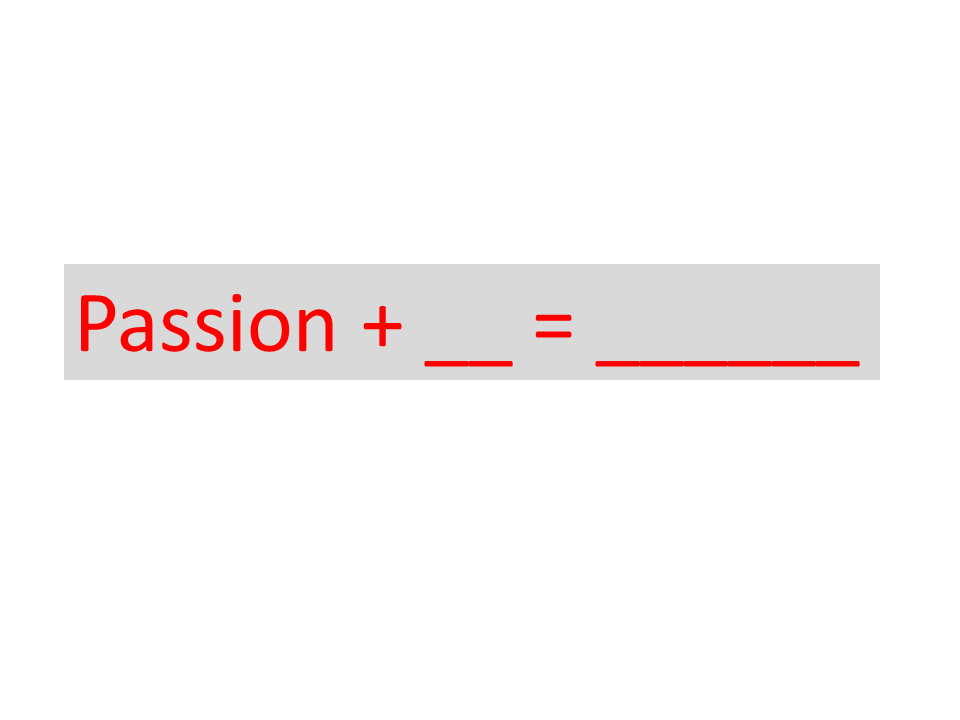
Passion is an input, not the sole determinant of brand strength or quality. Building on Newport’s focus on quality, my take is:

Passion + Proficiency = Professional Brand Equity

Proficiency is the composite of our capabilities- the education, training, skills, and behaviors that you can perform.

Where Are You?

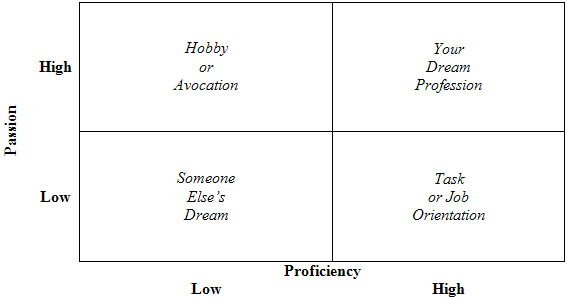
Below is a 2 x 2 matrix that categorizes professional brands based on one’s passion (emotional drive or motivation for a pursuit, activity, or job) and proficiency (capability to produce quality results related to a pursuit, activity, or job). The ideal quadrant is the upper right (high passion/high proficiency). When you operate in this space, work does not seem like work- it is truly a joy to be in your chosen field. The other three quadrants are problematic in their own way, with the lower left quadrant (low passion/low proficiency) being the worst possible situation. You do not want to be there; either circumstance or someone else put you in that place.

PBE

The other two quadrants call for reflection and evaluation if you are in one of them. For the upper left (high passion/low proficiency), can my passion be leveraged for a career opportunity? If yes, what skills or knowledge am I lacking needed to move to the upper right quadrant? The lower right quadrant is likely where many people among the 80% who do not like their jobs can be found. They are proficient in the field in which they work, but they are not driven by their passion nor finding passion in what they do. 

Do the Math

Use the equation of Passion + Proficiency = Professional Brand Equity as a guide for managing your professional brand. Do not dismiss the importance of passion, but at the same time do not blindly put faith in your passion leading to career success.

Biz Eye View: Building a Brand that Looks Different, Stays Agile

Editorial Note: This post is the first installment of a new feature, Biz Eye View. Innovative business professionals will be featured periodically, sharing their expertise to help you grow.

In marketing, we place a premium on differentiation. The opposite of differentiation is commoditization, the specter of which terrifies many marketers. It is easy to understand the importance of differentiation; the challenge resides in figuring out how to execute. This challenge is not limited to product brands. Differentiation is essential for building your personal brand and advancing your professional career, but moving from concept to action snags many people.

How to Survive and Thrive in the Jungle

For professionals looking for guidance on how to break out from commoditization, I recommend reading Zebras and Cheetahs: Look Different and Stay Agile to Survive the Business Jungle by Michael Burt and Colby Jubenville (Wiley, 2013). They acknowledge that there are no quick fixes or “Easy” buttons for developing your brand, but they tackle this problem through systematic questioning of assumptions and background to position ourselves for growth.

zccj

One of the creators of the Zebra/Cheetah model is Colby Jubenville, PhD. He is a professor, consultant, and strategist based in Murfreesboro, Tennessee. Colby shared his perspective on zebras, cheetahs, and differentiation.

DR: What inspired the Zebras and Cheetahs model? 

CJ: The model was developed with Coach Micheal Burt while sitting at Demos’ restaurant in Murfreesboro. A company challenged Micheal to dive monster growth over an 18-month cycle. We asked ourselves how we could make growing a company simple, easy and fun. The model is simple to understand because it is centered on a dominant focus that everyone can see and connect to. Once people understand the dominant focus of the organization, it’s easy for them to carry out the work that must be done that is related to the dominant focus.

DR: In your view, what are some obstacles that businesses and professionals face in the quest to “look different and stay agile?” 

CJ: Many experts tell others that they must differentiate. But, don’t follow that up with how one does that. To me it’s about answering one simple question: What is the unique value I deliver to others in the market?  Unique value is broken into three areas:

  1. Unique Perspective (How you see what you do)
  2. Unique Education (How you know what you do)
  3. Unique Experience (How you deliver what you do).

Understanding perspective, education and experience is critical to looking different.

Running Faster is about mindset and buying into this idea that we all need coaches in our lives. If you look back on your life, I would bet that a mentor/coach had conversations you didn’t want to have, made you do things you didn’t think you could do which led you to become something you didn’t think you could become. Coaches, in essence, teach us how to see and seize opportunity.

DR: How do you keep your personal brand focused on continuous development and growth? 

CJ: I think that starts with having a clear understanding of the unique value I deliver to the world.  I focus on helping organizations and people do three things: become better known, better understood, and better understand the unique value they deliver. Every decision about my brand and how I position myself goes through that filter.

Ask Questions to Understand Your Brand

One of the strengths of the Zebra/Cheetah model is the use of questions to gain perspective. Specifically, Burt and Jubenville encourage us to ask six questions for introspection to connect our past, present, and future:

  1. How is my perspective different from any other in the jungle?
  2. Through my education, what do I know that will give me and the tribe an added advantage?
  3. What are the top three experiences that have shaped who I am and who I want the tribe to become?
  4. What past struggles have helped me think better, make better decisions, and communicate in a way that the tribe understands?
  5. Where is the most opportunity for growth for me and my tribe?
  6. How can I make all of this simple and easy for others to understand?

Working harder isn’t the answer; trying your best isn’t the answer; completing checklists isn’t the answer; technology isn’t the answer. Developing a new perspective that will elevate our performance to a higher level is the answer. The Zebra/Cheetah model can help you navigate the concrete jungle and enable you to look different and stay agile while adding value to those with whom you serve.

Run like a Little Girl

dotpolka  via Flikr,
Creative Commons attribution

The phrase “run like a little girl” can hold unflattering meaning… particularly to little boys. But I learned today that I could benefit from running like a little girl. I began my day at the campus recreation center at my university (today is our department holiday luncheon and I needed to burn some calories before partaking of the holiday fare). During my run I observed a young couple and their daughter getting onto the track. The young girl had to be about 7 or 8-years old, probably out of school as many area counties prepared for a possible “iceageddon” in middle Tennessee. The family soon spread out around the track, each person having his or her own pace. It did not take long for me to realize the young girl knew something I did not.

Slow Down – Not
There was no way the parents would be keeping up with their daughter. The young girl ran stretches around the track at nearly a sprint, then settling into a more measured pace, and occasionally slowing to a walk. As I watched her sprint, I could not help but think to myself “Little girl- you better slow down and pace yourself.” After all, that is what I and most experienced runners do. I soon found myself admiring her energy and her being blissfully oblivious to the notion that she would somehow benefit from pacing herself. When her energy waned she slowed; when she felt energized she began sprinting again. Had she “paced herself,” she likely would not have had the same joyful experience. How do I know she had a joyful experience? The smile on her face and body language that suggested an absence of worry or fear made me admire her unorthodox running style all the more.

Pacing Ourselves is an Excuse
I went running this morning to burn calories and came away learning something that I already knew but have successfully denied to this point. The analogy of life as a marathon, not a sprint is one that resonates with me. Thus, pursuit of goals occurs in measured strides. After all, we would not want to burn out because we were running too fast, now would we? What a bunch of baloney that is. Too often, pacing ourselves is code for “I am scared of failure” or even “I am scared of success.” If we pace ourselves we can slow down so that we do not run head-on into either failure or success. Sadly, such a strategy can put us on a journey to nowhere as we work toward an outcome but get in our own way of getting there. Moreover, an obsession with pacing ourselves can deny the joys of the journey. The little girl was running hard, having fun, and not worried about her time or distance.

Resolve to Run like a Little Girl
The sight of the little girl running around the track will hopefully stick in my memory for a long time. I need to run like her, not necessarily on the track but in terms of how I approach projects, personal growth, and relationships. It is time to shed excuses and proclamations of “pacing myself” and allow myself to grow without self-imposed constraints.

What the Arctic Monkeys Taught Me about Branding

About a month ago, I treated my two oldest sons (24 and 17) to concert tickets to see one of their favorite alternative rock bands, the Arctic Monkeys. As the concert date approached, I realized this experience was going to be interesting for me. We would be seeing the band in a venue with no seats, and I knew they would like to get as close as possible. Counting the time in line outside the venue, waiting for the show to begin, and the concert itself, I spent nearly five consecutive hours standing up that evening while trying to co-exist with throngs of young fans crowding around. Not only did I survive the show, but I had a great time even though I was not very familiar with the band’s music.

If You Like Your Coffee Hot…
As I listened to songs from the band’s new album, AM, the lyrics of one song grabbed my attention.It is the track “I Wanna Be Yours.” It is a ballad, somewhat of a change of pace from the high energy packed into most Arctic Monkeys songs. One line from the song stopped me in my tracks. I cannot help but see connections between seemingly unrelated things like a ballad and branding, but this line had powerful parallel meaning for me. The line is innocent enough, almost hokey- “If you like your coffee hot, let me be your coffee pot.” But as I thought about the meaning of that line, I did not envision a guy longing for the company of a girl (or vice versa). Instead, I was reminded of what it means to create a brand that adds value by being in service to others… keeping their coffee hot, if you will.

…Let Me be Your Coffee Pot
Personal branding has gained favor as a strategy for managing one’s professional identity and career trajectory. One of the myths of personal branding is that it entails constant communication or demonstration of your expertise, particularly through social media channels. In reality, a great brand (personal or corporate) is one that adds value to others through service, leadership, mentoring, or coaching. It is not so much what you know, but what you do for others that positively impacts whether a brand prospers or wallows in medocrity. In my role as a college professor, the coffee pot imagery means to me that I serve as a mentor and advocate for my students as they sift through possible paths that ultimately lead to their career choices. I need to help “keep their coffee hot” as they progress through their studies and prepare to embark on their professional careers.

Be a coffee pot for someone-open yourself to keeping the coffee hot as you do your part to equip others to succeed. Below is a video of the Arctic Monkey performing an acoustic version of “I Wanna Be Yours.” Enjoy.